

This post contains affiliate links. As an Amazon Associate, I earn from qualifying purchases.
Introduction
Have you ever wondered how volcanoes erupt? With a simple homemade volcano experiment, you can recreate this powerful natural phenomenon right at home. Using everyday ingredients like baking soda and vinegar, this activity brings science to life in a fun, safe, and visually exciting way. It’s perfect for kids, students, and anyone curious about how chemical reactions work.
Why This Experiment Is So Popular
The homemade volcano experiment has remained a favorite for years because it combines learning with excitement. It helps explain both chemistry and earth science in a hands-on way.
From a scientific perspective, it demonstrates how gases are produced during reactions and how pressure can cause materials to burst outward—similar to real volcanic eruptions. Visually, the bubbling and flowing “lava” makes the experience engaging and memorable, especially for young learners.
Materials You’ll Need
To create your own erupting volcano, you only need a few simple materials that are easy to find at home:
A small plastic bottle
Baking soda (2–3 tablespoons)
Vinegar (about ½ cup)
Dish soap (a few drops)
Red or orange food coloring (for a realistic lava effect)
Clay, mud, or playdough (to shape the volcano)
A tray or outdoor area to manage the mess
These materials are safe and inexpensive, making the experiment accessible for everyone.
Step-by-Step Instructions
Start by placing the plastic bottle in the center of a tray or outdoor surface. Build a volcano shape around the bottle using clay or mud, leaving the opening at the top clear. This creates the structure of your volcano.
Next, add baking soda into the bottle. In a separate cup, mix vinegar with a few drops of dish soap and food coloring. When you pour this mixture into the bottle, step back and watch carefully. Within seconds, a foamy eruption will begin to flow out, resembling lava coming out of a volcano.
The Science Behind the Eruption 🧪
The exciting eruption is caused by a chemical reaction between baking soda and vinegar.
NaHCO3+CH3COOH→CO2+H2O+CH3COONa\text{NaHCO}_3 + \text{CH}_3\text{COOH} \rightarrow \text{CO}_2 + \text{H}_2\text{O} + \text{CH}_3\text{COONa}NaHCO3+CH3COOH→CO2+H2O+CH3COONa
In this reaction:
Baking soda (sodium bicarbonate) acts as a base
Vinegar (acetic acid) acts as an acid
The reaction produces carbon dioxide gas (CO₂)
This gas forms bubbles, and the dish soap traps these bubbles, creating thick foam. As the pressure builds, the foam overflows from the top, mimicking a volcanic eruption.
Real-World Connection 🌍
Although this experiment is simple, it represents real processes happening inside the Earth. In actual volcanoes, gases build up beneath the surface due to heat and pressure. When the pressure becomes too great, magma is forced out, causing an eruption.
Volcanoes also play an important role in shaping our planet. They form new land, create fertile soil for agriculture, and help scientists understand Earth’s internal structure.
Fun Variations to Try
You can make your volcano experiment even more exciting by trying a few variations. Use different food colors to create unique lava effects, or add glitter for a sparkling eruption. You can also try using warm vinegar to speed up the reaction or build a small “volcano village” around your model for a more realistic scene.
Conclusion
The homemade volcano experiment is a perfect blend of fun and learning. It turns simple household ingredients into a powerful demonstration of chemical reactions and natural processes. Whether you’re doing it for a school project or just for fun, it’s an activity that sparks curiosity and makes science easy to understand.
🌋 Try it yourself and experience the thrill of a volcanic eruption right at home!
❓ Frequently Asked Questions (FAQs)
Q1. Is the homemade volcano experiment safe for kids?
Yes, this experiment is completely safe when done under basic supervision. The ingredients used—baking soda, vinegar, and food coloring—are non-toxic and commonly found in households. However, it’s always a good idea to perform the experiment in an open space or on a tray to avoid mess.
Q2. Why does the volcano erupt?
The eruption happens because of a chemical reaction between baking soda (a base) and vinegar (an acid). This reaction produces carbon dioxide gas, which creates bubbles. When combined with dish soap, these bubbles form foam that overflows like lava.
Q3. Can I make the eruption bigger or more powerful?
Yes, you can increase the intensity by adding more baking soda or vinegar. Using warm vinegar can also speed up the reaction, making the eruption more vigorous. Adding more dish soap will create thicker and longer-lasting foam.
Q4. What does the dish soap do in the experiment?
Dish soap helps trap the carbon dioxide gas produced during the reaction. This creates a foamy texture, making the eruption look more like real flowing lava instead of just fizzing liquid.
Q5. How is this experiment similar to real volcanoes?
While real volcanoes involve molten rock (magma) and underground pressure, this experiment mimics the concept of gas buildup and release. In both cases, pressure forces material outward, creating an eruption.
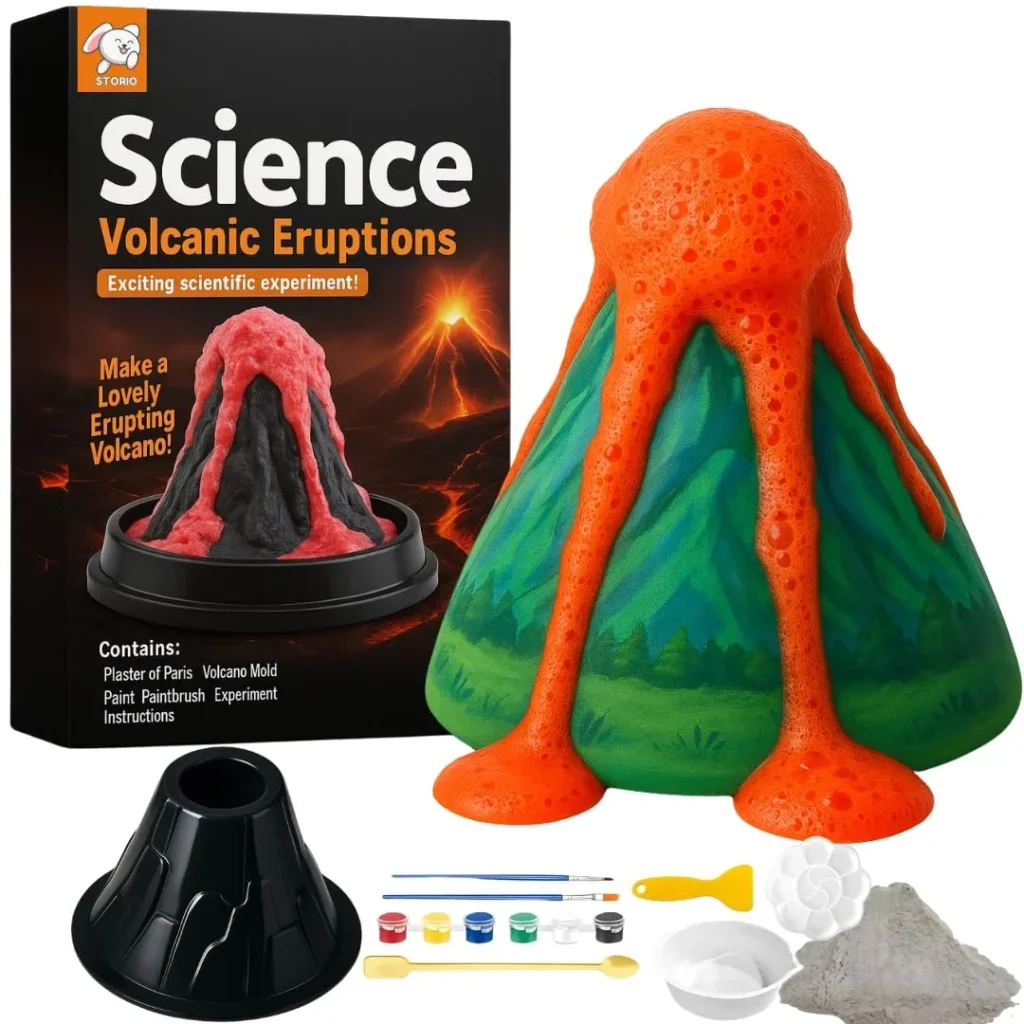
Storio Volcano Eruption DIY Science Kit for Kids | Make Your Own Volcano with Mold, Gypsum & Paint | Fun Learning Activity for Boys & Girls Age 5+ | STEM Educational Experiment Kit

100+ Science Experiments for Kids: Fun, Easy and Safe Science
Activities to Learn Physics, Chemistry and Biology at Home
Buy this book on Amazon
Easy Math for Kids
Fun and Simple Ways to Learn Numbers, Addition, Subtraction, Multiplication and Division for Ages 6-10 years.
Buy Now on Amazon
Advanced AI for Kids: Learn Artificial Intelligence, Machine Learning, Robotics, and Future Technology in a Simple Way
Explore Science with Fun Activities
Buy Now on Amazon