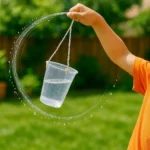
Why Build a Bottle Tornado?
Teaching fluid dynamics can feel abstract for students. A hand‑held vortex in a plastic bottle turns theory into a visual, tactile experience, and it’s inexpensive, safe, and quick to assemble. By watching the swirling air inside the bottle, learners grasp how wind rotation, pressure gradients, and conservation laws conspire to create powerful tornadoes. The experiment also illustrates vorticity, the measure of local rotation in a fluid, a key concept in physics, meteorology, and engineering.
📱 Download Our Apps on Google Play
Click any app below to install it from the Google Play Store.



What Is Vorticity?
Vorticity is a vector quantity denoted by ω (omega). In two‑dimensional flow, it’s often represented as ω = ∇ × v, where v is the velocity field. High vorticity means fluid elements spin around a core axis—a textbook definition of a vortex. In the bottle, the bottle’s interior becomes a miniature “storm cell,” and the swirling motion measured by your eyes is the visible component of vorticity.
For students seeking deeper detail, the Wikipedia entry on vorticity explains how it relates to the equations of motion for incompressible fluids.
Preparing the Experiment Materials
You only need a few household items:
- A clear plastic soda bottle (2‑liter size works best)
- Water (about 70 % of the bottle’s volume)
- Cotton, a paper towel, or a nylon sock to seal the mouth
- A small piece of cardboard or wooden stick for a wind‑meter feeler
- A plastic spoon (optional, for stirring the water slightly)
- A kitchen scale (to measure the weight of water, if precise data is needed)
Optional enhancements:
- Add a small amount of dish soap for reduced surface tension effects, but be careful—it can suppress curliness.
- Use a blue dye or tiny food coloring to help visualize the core.
Having a table or a workbench with a small fan or a hand fan nearby improves the quality of the vortex.
Step‑by‑Step Procedure
- Fill the bottle
Pour water into the bottle until it’s about 80 % full. - Seal the mouth
Place the cotton or sock over the opening and secure it tightly. - Create the initial swirl
Holding the bottle upside‑down, give it a quick swirl using both hands.
For more consistent spin, use a spoon or gently stir the water before sealing. - Add airflow
Hold the bottle horizontally and blow across the top edge with a fan or your mouth. - Observe
Watch the water rise and the spiraling jet form. Label the visible core and the surrounding fan‑shaped flow.
| Variable | Control | Expected Outcome |
| ——– | ——- | —————- |
| Water amount | 70‑80 % | Sufficient mass to resist gravity |
| Speed of initial swirl | Moderate | Adequate angular momentum |
| Airflow intensity | Medium | Creates a vortex but avoids turbulence |
Tip: Align the bottle’s axis with the direction of airflow to maximize symmetry.
How the Bottle Tornado Demonstrates Vorticity
When you blow across the bottle’s opening, the air’s velocity field generates a pressure drop along the axis, due to Bernoulli’s principle. This lower pressure draws the water upward, forcing it to rotate around the low‑pressure column. The rotation rate ψ (angular velocity) can be measured by timing how long it takes for the water to complete a spiral turn.
Mathematically, for a steady, incompressible flow, the vorticity ω equals twice the local angular velocity (ω = 2ψ). This simple relation is often highlighted in advanced fluid dynamics courses.
The bottle also shows conservation of angular momentum: As the air stream moves away from the bottle, the water’s rotation speed increases, just like a figure skater pulling in their arms.
Comparing Bottle Vortices to Natural Tornadoes
Natural tornadoes form in the atmosphere under complex processes—updrafts, temperature gradients, and large‑scale wind shear. While the bottle experiment is a dramatic simplification, it retains core physics:
- Kármán vortex shedding – The alternating pressure pattern that can occur when fluid encounters an obstacle, seen in the bottle as flickering swirls.
- Boundary layers – The layer of slower moving fluid close to the bottle’s wall, analogous to the boundary layer on a tornado’s surface.
- Pressure gradient forces – The bottle’s low‑pressure core versus the surrounding atmosphere.
For deeper comparison, the National Oceanic and Atmospheric Administration’s tornado page (NOAA tornado science) lays out the dynamics in accessible terms.
Scientific Extensions for Advanced Learners
If you’re looking to quantify the physics, consider the following extensions:
1. Measuring Vorticity Magnitudes
Attach a simple laser Doppler anemometer (LDA) or use a low‑cost ultrasonic flow sensor to record velocity profiles across the vortex. Compute vorticity as ω = dV/dx – dU/dy, where U and V are velocity components.
2. Adding Temperature Gradients
Warm the air beneath the bottle’s opening by placing a small electric heater in a safety‑approved holder. Observe how temperature differences amplify or dampen the vortex, akin to heat‑driven tornado genesis.
3. Computational Fluid Dynamics (CFD) Simulation
Model the experiment in OpenFOAM or ANSYS Fluent. Compare simulated vorticity fields to visual observations, illustrating how computational tools mirror real‑world experimentation.
Pedagogical Benefits
The bottle tornado experiment aligns with multiple educational standards:
- Science for All Students Act (SFAA) – Supports hands‑on inquiry learning.
- Next Generation Science Standards (NGSS) – HS‑PS1‑3 – “Analyze and interpret data obtained from rotating systems.”
- Physical Modeling & Simulation – Students gain intuition before tackling the Navier‑Stokes equations.
Teachers can integrate this activity into a unit on cyclonic weather systems or in a physics lab focusing on conservation laws and fluid motion.
Safety Considerations
Although safe, some precautions help maintain a smooth experience:
- Avoid forcing the water into the bottle to reduce splashing.
- Keep the cotton or sock away from sharp edges.
- Use plastic bottles that can withstand pressurization; replace broken ones before reuse.
Frequently Asked Questions
| Question | Answer |
| ——– | —— |
| Why does the water spiral upward? | The low pressure beneath the vortex pulls water upward, while conservation of angular momentum speeds the rotation. |
| Can I use a glass bottle? | Glass withstands lower pressure differences but may shatter if the seal fails. Stick to plastic for repeated use. |
| Does the type of water (distilled vs tap) matter? | No, but impurities can affect surface tension, subtly influencing the vortex quality. |
Call to Action
Ready to spin up your own bottle tornado? Grab a bottle, follow the steps, and let your classmates marvel at one of physics’ most elegant demonstrations. Share photos, videos, and measurements on platforms like Instagram or Google Scholar for community feedback. Encourage other educators to replicate the lab, and discuss what other fluid phenomena could be visualized in a container.
Conclusion
A tornado in a bottle is more than a neat trick—it’s a microcosm of atmospheric dynamics, showcasing the principles of vorticity, pressure gradients, and angular momentum. By translating complex equations into an accessible visual, educators can ignite curiosity, solidify conceptual understanding, and lay the groundwork for future exploration in meteorology, engineering, and applied physics. Whether you’re a high‑school teacher, a science club mentor, or simply a curious learner, this simple experiment offers a powerful gateway into the swirling world of fluid dynamics.

100+ Science Experiments for Kids
Activities to Learn Physics, Chemistry and Biology at Home
Buy now on Amazon
Advanced AI for Kids
Learn Artificial Intelligence, Machine Learning, Robotics, and Future Technology in a Simple Way...Explore Science with Fun Activities.
Buy Now on Amazon
Easy Math for Kids
Fun and Simple Ways to Learn Numbers, Addition, Subtraction, Multiplication and Division for Ages 6-10 years.
Buy Now on Amazon🚀 Try These Free Android Apps
Download these useful apps directly from the Google Play Store.