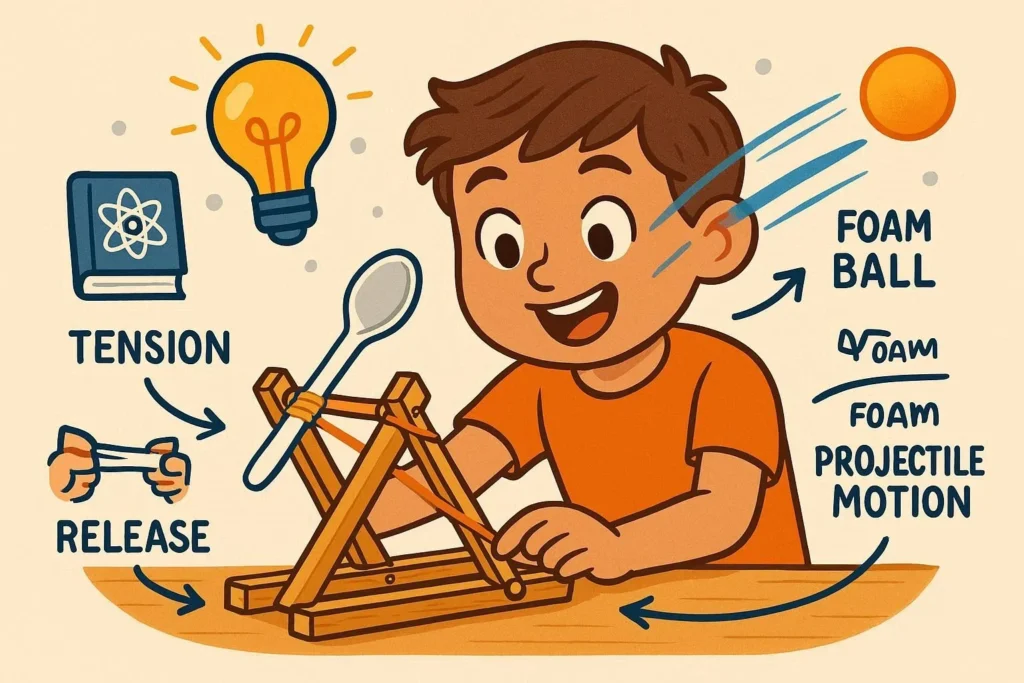

Understanding physics principles becomes incredibly engaging when you transform theory into tangible projects. Constructing a miniature catapult offers the perfect hands-on opportunity to investigate fundamental mechanics concepts. This experiment demonstrates how projectile motion relates to applied force and launch angles using accessible materials. Before beginning, ensure your workspace is clear and safety glasses are worn during testing phases.
📱 Download Our Apps on Google Play
Click any app below to install it from the Google Play Store.

Essential Catapult Building Materials
You’ll need common household items: craft sticks, rubber bands, a plastic spoon, glue, and a milk carton cap. Optionally, use measuring tape for recording results and marbles as consistent projectiles. Securely attach the spoon to upright craft sticks using sturdy rubber bands—this pivoting arm design creates the core mechanism. Reinforce joints with non-toxic glue for stability. Prepare alternative ammunition like plastic beads or dryer lint balls if marbles aren’t available.
Constructing Your Experiment Catapult
- Assemble the base by crossing two craft sticks into an X shape
- Mount upright supports vertically at rear corners with rubber bands
- Affix the spoon to the top of the uprights using multiple bands
- Reinforce pivot points with glue drops
- Attach milk cap to spoon end using glue
The elastic potential energy stored in stretched rubber bands converts to kinetic energy when released. According to Physics Classroom, elastic energy accounts for motion transfer but experiences gradual efficiency loss through friction.
Force Measurement Techniques
Quantify force application by labeling pull-back positions on your launch pad. Mark reference increments behind the catapult to standardize pull distances. Remember: Longer pull distances require greater force exertion and correlate directly with elastic band tension. NASA’s rocket propulsion guides illustrate how increased applied force generates higher acceleration rates. Note that varying rubber band thickness significantly alters potential energy output.
Distance Testing Methodology
Establish a consistent testing protocol: maintain ammunition weight throughout trials and launch from level flooring. Measure distances using tape measures secured with painter’s tape. Conduct ten launches per pull-back position and calculate average ranges. Record variables meticulously:
- Rubber band tension level
- Pull-back angle
- Projectile mass
- Displacement measurements
Physics Principles Demonstrated
Your catapult showcases Newton’s Second Law: Force equals mass times acceleration (F=ma). Greater rubber band tension increases projectile acceleration magnitude upon release. Launch angles critically impact distance outcomes—projections between 40-45 degrees yield maximum horizontal displacement as confirmed by University of Hawaii physics texts. The relationship between release tension and landing position illustrates kinetic energy transfer efficiency.
Optimizing Catapult Performance
Adjust design variables systematically to enhance functionality. Increase projectile velocity through:
- Multiple rubber bands configuration
- Extended throwing arm adaptation
- Cup-shaped projectile holders
Conduct friction reduction tests by smoothing pivot points with beeswax. Achieve remarkable consistency by prototyping side stabilizers that prevent lateral movement during launches.
Educational Applications
Classroom application aligns with NGSS motion standards. Educators document improved STEM engagement through tactile physics modeling. Modify setups exploring momentum conservation by catching launched items in hanging baskets. Integrate mathematics using Pythagorean calculations for trajectory vectors.
This catapult experiment proves physics transcends textbook diagrams through tangible discovery. Each controlled launch reveals interconnected force-transmission concepts. Now assemble those craft sticks and deepen your mechanical intuition—engineer your miniature trebuchet today! Catalog discoveries incrementally since subtle modifications yield profound learning moments.

100+ Science Experiments for Kids
Activities to Learn Physics, Chemistry and Biology at Home
Buy now on Amazon
Advanced AI for Kids
Learn Artificial Intelligence, Machine Learning, Robotics, and Future Technology in a Simple Way...Explore Science with Fun Activities.
Buy Now on Amazon
Easy Math for Kids
Fun and Simple Ways to Learn Numbers, Addition, Subtraction, Multiplication and Division for Ages 6-10 years.
Buy Now on Amazon🚀 Try These Free Android Apps
Download these useful apps directly from the Google Play Store.