
Introduction
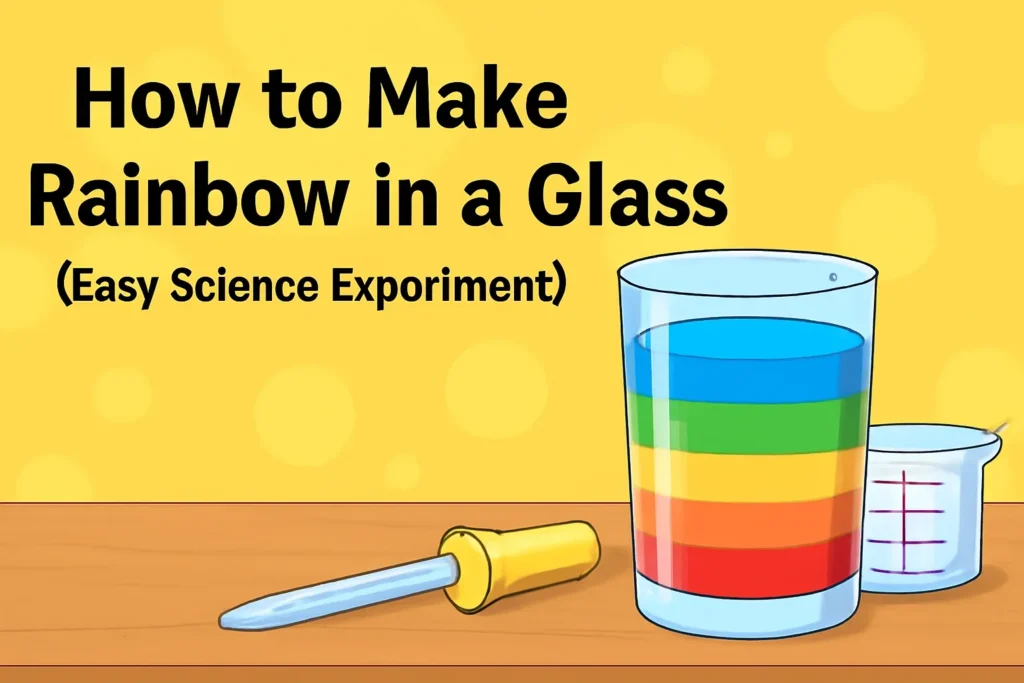
Imagine holding a rainbow in your hands! 🌈 With just sugar, water, and a few drops of food coloring, you can create a stunning layered rainbow inside a glass.
📱 Download Our Apps on Google Play
Click any app below to install it from the Google Play Store.

This simple yet eye-catching experiment is more than just fun—it’s a hands-on way to understand an important scientific concept called density. Perfect for kids, students, and curious minds, it turns everyday ingredients into a beautiful science demonstration.
What You’ll Need 🧪
Gather these simple materials before you begin:
4 clear glasses or cups
Water
Sugar
Food coloring (red, yellow, green, blue)
A spoon for stirring
One tall clear glass for layering
💡 Tip: Use transparent glasses so you can clearly see the layers forming.
Step-by-Step Instructions
1. Prepare Colored Solutions 🎨
Fill each of the 4 glasses with the same amount of water. Add a different food color to each glass—red, yellow, green, and blue.
2. Add Sugar in Layers 🍬
Now, create different densities by adding sugar:
Red glass: 3 tablespoons of sugar
Yellow glass: 2 tablespoons of sugar
Green glass: 1 tablespoon of sugar
Blue glass: No sugar
Stir each glass thoroughly until the sugar is completely dissolved.
3. Layer the Colors 🥄
Take your tall clear glass and carefully pour the liquids in this order:
Red (most sugar, most dense)
Yellow
Green
Blue (least dense)
👉 Pro Tip: Pour slowly over the back of a spoon to prevent the layers from mixing.
4. Watch the Rainbow Form 🌈
If done carefully, the liquids will stack on top of each other, forming a beautiful rainbow effect. Each layer stays separate, creating a stunning visual display.
Why Does It Work? (The Science Explained)
The key concept behind this experiment is density.
Density refers to how much mass is packed into a given volume of a substance
When sugar is added to water, it increases the liquid’s density
More sugar = heavier (denser) liquid
Less sugar = lighter liquid
👉 By pouring from the most dense to least dense, the liquids stay separated instead of mixing.
This principle is widely used in science and engineering, from ocean studies to industrial fluid systems.
Fun Variations to Try 🔬
Make your rainbow experiment even more exciting:
Add more layers: Use different sugar quantities to create additional colors
Try other liquids: Use honey, oil, or dish soap for more density differences
Glow effect: Shine a flashlight through the glass for a magical rainbow look
Temperature twist: Test with warm vs cold water and observe changes
These variations help deepen your understanding of how liquids behave.
Real-World Connections 🌍
This simple experiment connects to real-life science:
Ocean layers: Different water densities create layers in oceans
Atmospheric science: Air density affects weather patterns
Industrial processes: Density separation is used in chemical industries
It shows how basic principles apply to complex natural systems.
Safety Note ⚠️
This experiment is completely safe to perform, but the final mixture is not meant for drinking due to the high sugar content.
Conclusion
The “Rainbow in a Glass” experiment is a perfect blend of science and creativity. It transforms simple kitchen ingredients into a colorful demonstration of density and liquid behavior.
Whether you’re doing it for fun, a school project, or just curiosity, this experiment proves that science can be both beautiful and educational.
🌈 Try it yourself and bring a rainbow to life—right in your glass! ✨

100+ Science Experiments for Kids
Activities to Learn Physics, Chemistry and Biology at Home
Buy now on Amazon
Advanced AI for Kids
Learn Artificial Intelligence, Machine Learning, Robotics, and Future Technology in a Simple Way...Explore Science with Fun Activities.
Buy Now on Amazon
Easy Math for Kids
Fun and Simple Ways to Learn Numbers, Addition, Subtraction, Multiplication and Division for Ages 6-10 years.
Buy Now on Amazon🚀 Try These Free Android Apps
Download these useful apps directly from the Google Play Store.