
Parents and teachers are always looking for engaging, hands‑on activities that spark curiosity while reinforcing core concepts. Easy science experiments kids can do at home provide the perfect blend of learning and fun, turning the kitchen, garden, or living room into a miniature laboratory. These activities require minimal supplies, follow safety best practices, and align with STEM education goals, making them ideal for family night, rainy‑day play, or supplemental classroom lessons. Below you’ll find ten tried‑and‑true projects that build confidence, illustrate fundamental principles, and encourage the scientific method without breaking the bank.
Easy Science Experiments Kids: The Magic of Everyday Materials
Every household holds the raw ingredients for a surprising number of discoveries. By repurposing common items, children learn that science is all around them.
- Rainbow Milk – Fill a shallow dish with whole milk, add drops of food coloring, then gently place a cotton swab dipped in dish soap. Watch the colors swirl in a dazzling display of surface tension and density.
- Invisible Ink Messages – Use lemon juice or diluted white vinegar as a secret ink. Write on plain paper and reveal the hidden text by gently heating the page with a hair dryer or a warm lamp, demonstrating oxidation reactions.
- Balloon Rocket – Thread a long piece of string through a straw, anchor the string at two points, tape an inflated balloon to the straw, and let go. The escaping air propels the balloon along the string, illustrating Newton’s Third Law.
Easy Science Experiments Kids: Classic Experiments with a Twist
Traditional projects are timeless for a reason, but adding a small variation can renew interest and deepen understanding.
- Volcano Eruption (Baking Soda & Vinegar) – Mix baking soda, a few drops of dish soap, and red food coloring in a constructed clay volcano. Add vinegar to ignite a fizzy eruption, showcasing an acid‑base reaction. Try using different ratios to explore reaction rates.
- Egg Drop Challenge – Provide everyday protective materials (paper towels, bubble wrap, rubber bands). Teams design a container that keeps a raw egg intact when dropped from a height, encouraging engineering design and force distribution concepts.
- Static Electricity Dance – Rub a balloon on wool or hair, then bring it close to small paper pieces or a stream of water from a faucet. The static charge attracts the paper or bends the water stream, illustrating electrostatic forces.
Easy Science Experiments Kids: Exploring Chemistry Safely
Simple chemical reactions can be both safe and spectacular when proper supervision is provided. These experiments reinforce the idea that chemicals are not just lab‑only substances.
- Homemade pH Indicator – Boil red cabbage leaves to extract a purple solution. Test household liquids (lemon juice, soda, soap water) and observe color changes that reveal acidity or alkalinity, introducing the pH scale.
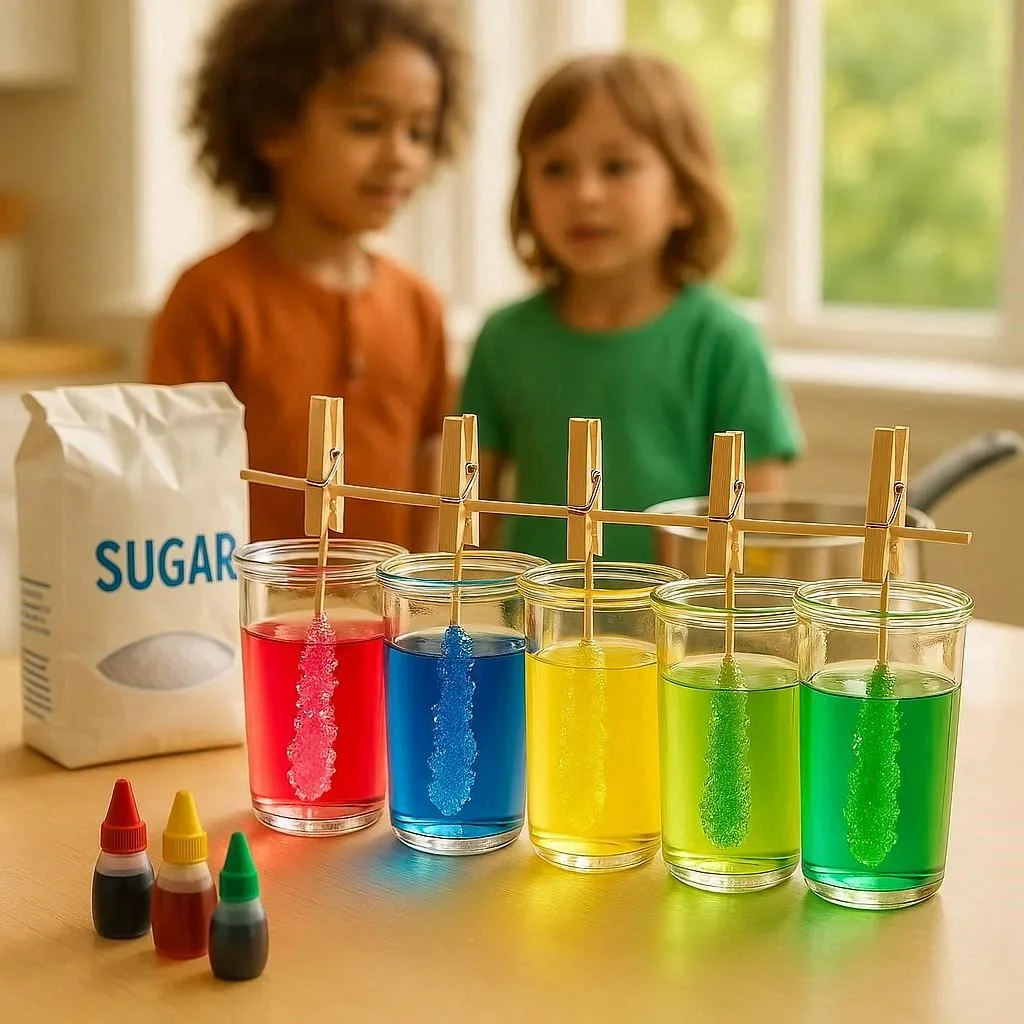
- Crystal Growing – Dissolve equal parts of salt or sugar in warm water until saturated. Hang a string or pipe cleaner, let the solution evaporate, and watch crystals form. This demonstrates supersaturation and crystal lattice formation.
- DIY Science experiment Slime – Combine white school glue, water, and a small amount of borax solution. Kids can stretch, squeeze, and observe the non‑Newtonian fluid behavior, a fun entry point to polymer chemistry.
Easy Science Experiments Kids: Physics Fun for Mini Scientists
From forces to optics, simple setups can illuminate complex ideas. These activities are perfect for curious minds who love to see how things move and interact.
- Water Refraction Prism – Fill a clear glass with water and place a small mirror at an angle inside. Shine a flashlight onto the mirror and watch the light bend, demonstrating refraction and the basics of optics.
- Paper Airplane Aerodynamics – Challenge kids to design and test different paper airplane shapes. Record flight distance and stability, discussing lift, drag, and center of gravity. Use a simple spreadsheet to compare data.
- Magnetic Field Mapping – Scatter iron filings on a sheet of paper and place a bar magnet underneath. The filings align along magnetic field lines, visualizing invisible forces. Try using different magnet shapes to compare patterns.
These eleven projects (including variations) provide a rich toolbox for home science activities that nurture curiosity and reinforce classroom learning. By documenting observations, forming hypotheses, and discussing results, children practice the NASA Kids Club recommended approach to the scientific method.
Tips for Safe and Successful Experiments
Safety and structure are essential for a positive experience. Follow these guidelines:
- Supervision: Always have an adult present, especially when using heat, sharp objects, or chemicals.
- Protective Gear: Use goggles, gloves, or aprons as needed. Simple kitchen gloves work for many projects.
- Clean‑up Plan: Prepare a designated area with paper towels, a trash bin, and a washable surface.
- Record Findings: Encourage kids to keep a science journal—drawings, notes, and photos help cement learning.
- Resource Exploration: Visit reputable sites such as the U.S. Department of Education STEM page for additional ideas and curriculum alignment.
Integrating these steps assures that each activity remains fun, educational, and safe.
Conclusion
Ready to turn everyday moments into unforgettable learning experiences? Try these easy science experiments kids can do at home and watch their confidence soar. Share your favorite results on social media, tag us, and let other families join the discovery journey. For more project ideas, visit our blog or sign up for the monthly newsletter. Start experimenting today and inspire the next generation of scientists!
Frequently Asked Questions
Q1. How safe are the easy science experiments kids can do at home?
All the projects use everyday household items and non‑hazardous substances. Supervision by an adult is recommended for any step involving heat, sharp tools, or chemicals. Simple protective gear such as goggles or kitchen gloves adds an extra layer of safety.
Q2. What supplies do I need for most of these experiments?
Most activities require items you already have, such as milk, food coloring, balloons, baking soda, vinegar, and paper. A few experiments may need additional tools like a straw, a small mirror, or a measuring cup. A basic science‑journal and a clean workspace help keep everything organized.
Q3. How can I turn a fun experiment into a learning experience?
Encourage children to write down a hypothesis before starting, then observe and record results. Ask guiding questions about why the reaction happened or which variables could be changed. Discuss the underlying scientific principle after the activity ends.
Q4. Are these experiments aligned with school curricula?
Yes, the projects reinforce core STEM standards, covering topics such as surface tension, acid‑base reactions, forces, and optics. Teachers can map each experiment to specific grade‑level objectives, making them useful for classroom extensions or homework.
Q5. How often can we do these experiments without buying new materials?
Most experiments can be repeated several times because the supplies are inexpensive and abundant. Items like food coloring, baking soda, and balloons are easy to restock, while reusable tools such as straws, containers, and magnets can be used indefinitely.
Related Articles

100+ Science Experiments for Kids
Activities to Learn Physics, Chemistry and Biology at Home
Buy now on Amazon
Advanced AI for Kids
Learn Artificial Intelligence, Machine Learning, Robotics, and Future Technology in a Simple Way...Explore Science with Fun Activities.
Buy Now on Amazon
Easy Math for Kids
Fun and Simple Ways to Learn Numbers, Addition, Subtraction, Multiplication and Division for Ages 6-10 years.
Buy Now on Amazon

