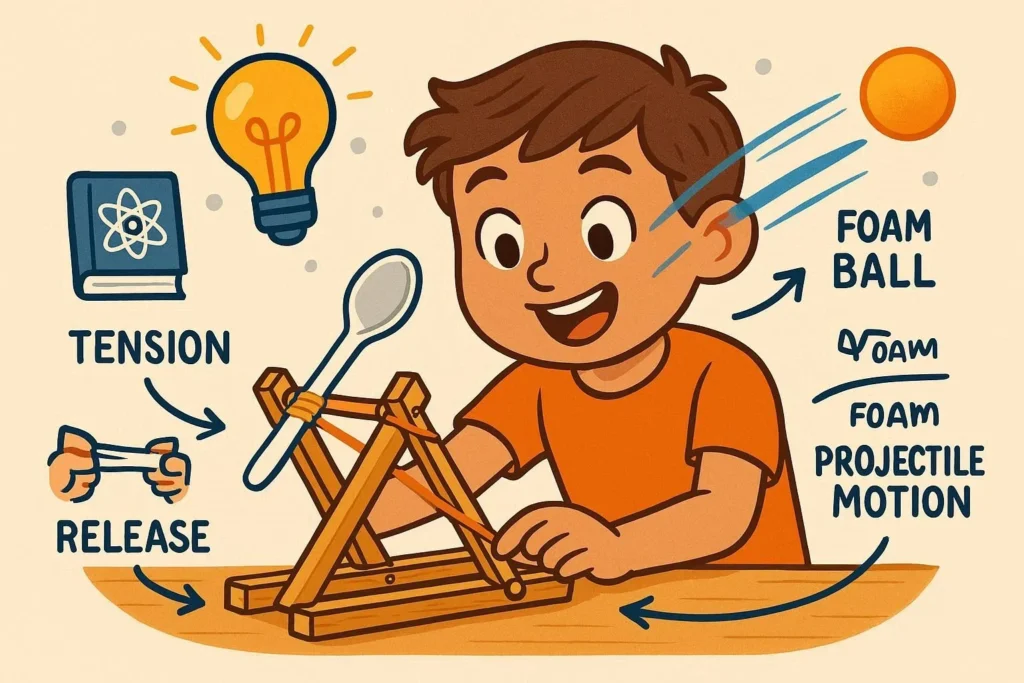

The allure of a perfectly toasted marshmallow, combined with the simple joy of launching it across a room, has sparked an intriguing idea: a miniature catapult. But beyond the whimsical fun lies a fascinating opportunity to explore fundamental principles of projectile motion – specifically, the physics behind why things fly! This blog post delves into building a functional marshmallow catapult and then analyzes the key concepts involved in understanding how projectiles move through the air. It’s not just about making something that *looks* cool; it’s a hands-on project that can dramatically enhance your understanding of physics principles, encouraging critical thinking and problem-solving skills.
Understanding the Basics: Launching Principles
Before we begin construction, let’s establish a foundational understanding. A projectile – anything launched into the air – is propelled by an initial force acting downwards. The key to a successful launch lies in understanding several factors: mass, velocity, and angle of release. Mass is simply the amount of matter in an object; heavier objects require more force to achieve the same velocity. Velocity describes how fast an object is moving. And crucially, the angle at which you release the projectile significantly impacts its trajectory – a steeper angle results in a higher launch angle and greater horizontal distance.
The Role of Gravity
Gravity is the universal force that pulls everything towards the Earth’s center. It’s what keeps us firmly planted on the ground, and it directly affects the path of any projectile launched upwards. As the marshmallow catapult launches, gravity constantly acts upon it, slowing its upward motion until it reaches a point where its velocity momentarily stops before falling back down.
Building Your Marshmallow Catapult: A Step-by-Step Guide
Let’s break down the construction process. You’ll need several readily available materials: a sturdy cardboard box, a popsicle stick or similar lightweight material for the arm, a marshmallow, rubber bands, tape, scissors, and optionally, some small weights (like pennies or washers) to add stability.
- Construct the Base: Begin by cutting a rectangular piece of cardboard to form the base of your catapult. This should be large enough to comfortably hold the marshmallow and allow for a stable launching platform.
- Create the Arm: Cut a popsicle stick or similar material into two equal lengths. These will serve as the arm of your catapult.
- Attach the Arm to the Base: Securely tape the arm to the base, ensuring it’s positioned at a 90-degree angle relative to the cardboard. The angle is critical for launching the marshmallow effectively.
- Construct the Launching Mechanism: This is where the rubber bands come in. Attach one end of each rubber band to the top of the arm. The length of the rubber band will determine the range of your catapult. Experiment with different lengths to find what works best.
- Test and Refine: Carefully launch a marshmallow! Observe its trajectory and make adjustments to the arm angle, rubber band length, or even the weight distribution to optimize performance.
Analyzing Projectile Motion – The Physics Behind the Launch
Now that we’ve built our catapult, let’s delve into the physics behind why it works. We can use a simplified model to understand key concepts: Bernoulli’s Principle and Newton’s Third Law.
Bernoulli’s Principle
Bernoulli’s principle describes how air pressure decreases as velocity increases. When the marshmallow is launched, the air rushing out of the opening creates lower pressure above it compared to the higher pressure below. This difference in pressure generates an upward force – the thrust that propels the marshmallow forward.
Newton’s Third Law
Newton’s Third Law states that for every action, there is an equal and opposite reaction. The catapult exerts a downward force on the marshmallow (the action), and the marshmallow exerts an upward force on the catapult (the reaction). This reciprocal interaction is what allows the launch to occur.
Advanced Concepts & Experimentation
Beyond the basic principles, you can explore more advanced concepts. Consider experimenting with different marshmallow sizes or shapes. A larger marshmallow will generally travel further, but it might also be harder to launch accurately. Varying the angle of release and the length of the rubber bands can dramatically impact the trajectory. You could even try incorporating a small weight into the arm to increase stability – this is particularly useful for launching from slightly uneven surfaces.
Safety Considerations
While a marshmallow catapult is generally safe, it’s important to prioritize safety. Always launch the marshmallow away from people and fragile objects. Supervise children closely during construction and use. Ensure that the catapult is stable and won’t tip over easily. Avoid launching marshmallows at windows or other surfaces where they could cause damage.

100+ Science Experiments for Kids
Activities to Learn Physics, Chemistry and Biology at Home
Buy now on Amazon
Advanced AI for Kids
Learn Artificial Intelligence, Machine Learning, Robotics, and Future Technology in a Simple Way...Explore Science with Fun Activities.
Buy Now on Amazon
Easy Math for Kids
Fun and Simple Ways to Learn Numbers, Addition, Subtraction, Multiplication and Division for Ages 6-10 years.
Buy Now on Amazon