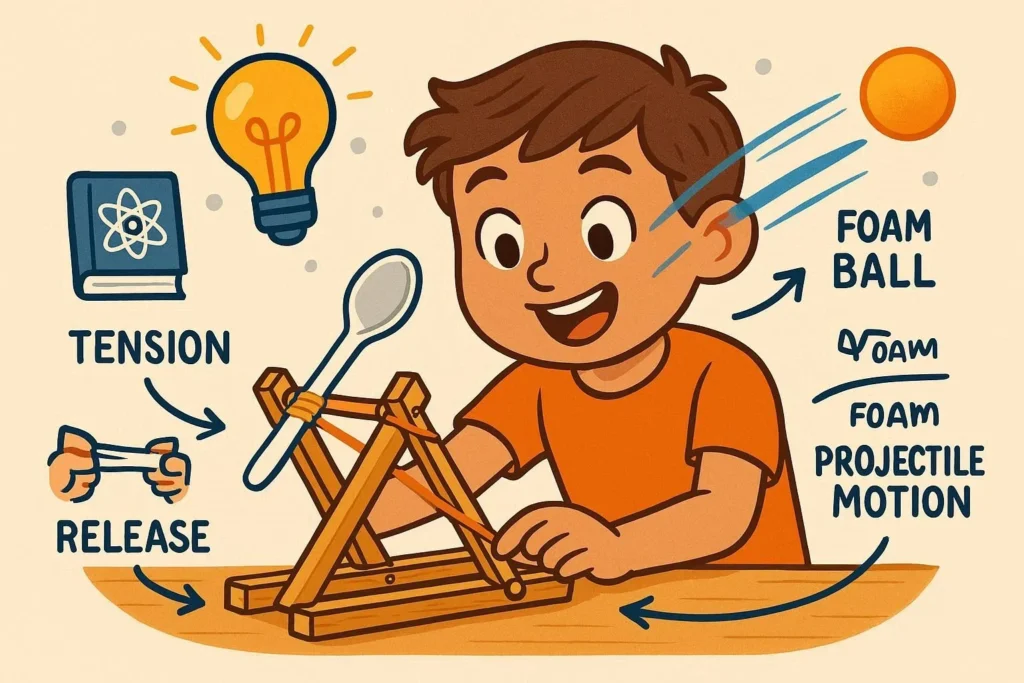

Ever wondered how a simple marshmallow catapult can turn a kitchen experiment into a physics lesson? By building a homemade catapult and launching marshmallows, you can observe the principles of projectile motion, measure trajectory, and test launch angles—all while having fun. This guide walks you through the materials, construction steps, safety tips, and data collection methods so you can turn a playful activity into a rigorous study of physics.
📱 Download Our Apps on Google Play
Click any app below to install it from the Google Play Store.


Materials and Safety Checklist
Before you start, gather the following items and review the safety checklist. Safety first ensures that your experiment is both educational and enjoyable.
- Sturdy cardboard or plywood (1/4″ thick) for the base and arm
- Elastic bands or rubber tubing (high‑strength, 1/4″ diameter)
- Wooden dowel or plastic rod (1/2″ diameter, 12–18″ long)
- Marshmallows (regular or mini, depending on desired projectile size)
- Scissors, utility knife, and ruler
- Hot glue gun or strong adhesive
- Safety goggles and a clear launch area
Check that the launch area is free of obstacles and that all participants wear eye protection. The elastic bands should be inspected for cracks or wear before each launch.
Step‑by‑Step Construction
Follow these steps to assemble a functional marshmallow catapult that will reliably launch your projectiles.
- Base Construction: Cut a rectangular base (12″ x 6″) from the cardboard or plywood. Reinforce the corners with additional strips of cardboard to prevent warping.
- Arm Attachment: Attach the wooden dowel to the base using hot glue. The dowel should be positioned so that its free end can swing freely when tension is applied.
- Elastic Band Harness: Wrap the elastic band around the dowel near the base, securing it with a small clamp or a second piece of cardboard. The band should be taut enough to store potential energy but not so tight that it breaks.
- Launch Platform: Create a small cradle at the free end of the dowel using a piece of cardboard or a plastic cup. This cradle will hold the marshmallow during launch.
- Angle Adjustment: Install a simple hinge or pivot at the base to allow you to adjust the launch angle. A protractor can help you set precise angles for systematic testing.
Once assembled, test the catapult with a single marshmallow to ensure smooth motion and adequate tension. Adjust the elastic band or arm length if the launch feels too weak or too powerful.
Measuring Projectile Motion
With your catapult ready, you can now collect data on projectile motion. The key variables to record are launch angle, initial velocity, and flight distance. Use a measuring tape or a laser rangefinder for accuracy.
1. Launch Angle: Set the catapult to a specific angle (e.g., 30°, 45°, 60°). Record the angle using a protractor.
2. Initial Velocity: Estimate the initial velocity by timing the flight of the marshmallow over a known distance. Alternatively, use a high‑speed camera to capture the launch and calculate velocity from frame‑by‑frame analysis.
3. Flight Distance: Measure the horizontal distance from the launch point to the landing spot. Repeat each launch at least five times to obtain an average distance.
Plot the data on a graph of distance versus launch angle. According to the physics of projectile motion, the maximum range occurs at a 45° launch angle when air resistance is negligible. Compare your experimental results with the theoretical prediction from the equation R = (v2 sin 2θ)/g, where v is initial velocity, θ is launch angle, and g is gravitational acceleration (9.81 m/s²).
Exploring Air Resistance and Mass Effects
Marshmallows are not perfect projectiles—they deform and experience significant air resistance. To study these effects, vary the marshmallow size or use different materials (e.g., foam balls). Observe how heavier or more aerodynamic projectiles alter the trajectory.
Use the following approach:
- Keep the launch angle constant.
- Launch marshmallows of varying mass and record the flight distance.
- Plot distance versus mass to see the inverse relationship predicted by the drag equation.
These experiments illustrate real‑world deviations from the ideal projectile model, providing a deeper understanding of how forces like drag influence motion.
Connecting to Classroom Learning
Teachers can incorporate the marshmallow catapult into lessons on kinematics, energy transfer, and experimental design. Students can:
- Form hypotheses about launch angle and range.
- Design controlled experiments to test their predictions.
- Use statistical analysis to evaluate the significance of their results.
- Present findings in a poster or digital report.
These activities reinforce the scientific method and help students see the relevance of physics in everyday life.
Resources for Further Exploration
For those interested in deeper theoretical background or advanced experimentation, consult the following authoritative sources:
- Projectile Motion – Wikipedia
- NASA Experiments on the ISS
- MIT OpenCourseWare – Classical Mechanics
- Ohio State University Physics Resources
Conclusion and Call to Action
By building a marshmallow catapult and systematically studying projectile motion, you transform a simple kitchen toy into a powerful educational tool. This hands‑on experiment demonstrates how energy, force, and motion interact in the real world, while also highlighting the importance of careful measurement and data analysis. Whether you’re a student, teacher, or curious hobbyist, the insights gained from this project can deepen your appreciation for physics and inspire further exploration.
Ready to launch your own experiment? Grab the materials, follow the steps, and start measuring today. Share your results with friends or classmates and spark a conversation about the science behind every launch!
Frequently Asked Questions
Q1. What materials do I need to build a marshmallow catapult?
You’ll need a sturdy base such as 1/4″ cardboard or plywood, a wooden dowel or plastic rod for the arm, high‑strength elastic bands or rubber tubing, and a small cradle to hold the marshmallow. A hot glue gun or strong adhesive will secure the arm to the base, and a protractor helps set launch angles. Safety goggles are essential, and a clear launch area free of obstacles is required. Optional items include a measuring tape or laser rangefinder for data collection and a high‑speed camera for velocity analysis.
Q2. How can I ensure the experiment is safe for everyone?
Always wear safety goggles and keep the launch area clear of people and fragile objects. Inspect elastic bands for cracks before each launch and replace them if necessary. Secure the base firmly to prevent wobbling, and use a stable surface to avoid accidental tipping. Keep the launch angle moderate to avoid high‑velocity impacts that could cause injury.
Q3. How do I measure the launch angle accurately?
Attach a protractor to the base or use a digital angle finder to set the desired launch angle. Mark the angle on the base with a pencil for consistency. Adjust the pivot until the arm aligns with the marked angle, and double‑check with the protractor before each series of launches. Recording the angle in a data sheet ensures repeatability.
Q4. What factors influence the range of a marshmallow launched from a catapult?
The primary factors are the initial velocity, launch angle, and air resistance. The elastic band’s tension determines how much potential energy is converted to kinetic energy. The marshmallow’s mass and shape affect drag, while the launch angle dictates the balance between vertical and horizontal components of velocity. Environmental conditions like wind can also alter the trajectory.
Q5. Can I use other projectiles besides marshmallows?
Yes, you can experiment with foam balls, ping‑pong balls, or small plastic spheres. Each projectile’s mass, size, and aerodynamic properties will change the flight path, allowing you to study different aspects of projectile motion. Just ensure the cradle can securely hold the new projectile and that safety precautions remain in place.
Related Articles

100+ Science Experiments for Kids
Activities to Learn Physics, Chemistry and Biology at Home
Buy now on Amazon
Advanced AI for Kids
Learn Artificial Intelligence, Machine Learning, Robotics, and Future Technology in a Simple Way...Explore Science with Fun Activities.
Buy Now on Amazon
Easy Math for Kids
Fun and Simple Ways to Learn Numbers, Addition, Subtraction, Multiplication and Division for Ages 6-10 years.
Buy Now on Amazon🚀 Try These Free Android Apps
Download these useful apps directly from the Google Play Store.