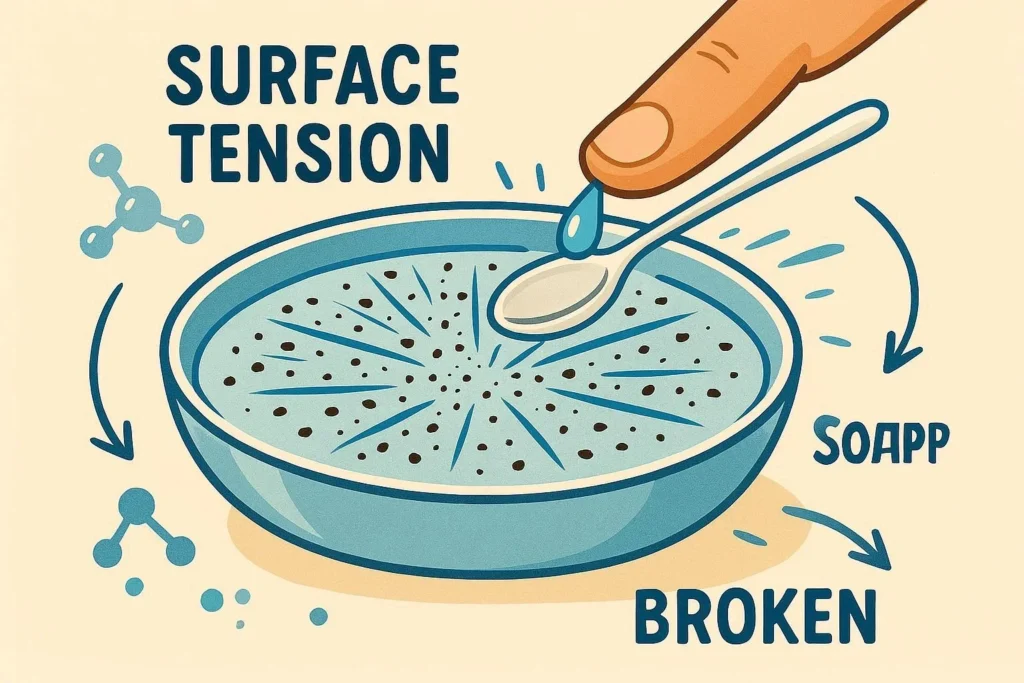

Surface tension is the subtle resistance that the free surface of a liquid exerts against external forces. This force, arising from cohesive interactions among molecules, gives water and many other fluids a skin‑like behavior that can support light objects and produce menisci around immersed objects. When we observe a droplet of water on a smooth tabletop, we can see the rounded profile caused by surface tension pulling the surface inward. Understanding this property explains why a paperclip can sit on water, why oily droplets spread, and, intriguingly, why certain insects can walk on the water surface—an extraordinary dance of physics that has inspired biomimetic designs in engineering and robotics.
📱 Download Our Apps on Google Play
Click any app below to install it from the Google Play Store.



Surface Tension: Physical Definition
According to the Surface Tension Wikipedia article, this phenomenon quantifies the energy required to increase a liquid’s surface area by a unit. Surface tension is expressed in newtons per meter (N/m) or dynes per centimeter (dyn/cm) and reflects the balance between cohesive forces inside the liquid and adhesive forces at the interface. For fresh water at room temperature, the value is approximately 0.072 N/m, enabling tiny organisms and droplets to exhibit remarkable stability. Surface tension originates from the asymmetry of molecular bonds: molecules in the bulk are pulled equally by neighbors, while surface molecules experience an unbalanced inward pull. This results in a net force that contracts the surface, much like the taut skin of a balloon. Hydrophobic substances reduce water’s surface tension by disrupting these hydrogen bonds, causing droplets to spread more readily—an effect that underlies many everyday observations.
Surface Tension Enables Insects to Walk
Many water‑walking insects, notably water striders, exploit surface tension by using their elongated, hydrophobic legs to distribute their weight across a large area. This principle is described by the Capillary Action entry, which highlights how surface tension generates vertical forces that support weight. A water strider’s legs are covered in microscopic hairs that trap air, generating a cushion that increases the effective contact area. As a result, the downward gravitational force is balanced by the upward surface tension, allowing the insect to stay aloft. The key to this locomotion lies in the interplay between the contact angle—controlled by hydrophobic surface chemistry—and the meniscus shape around each leg. When the legs are angled just right, they push water outward, creating a negative pressure that counteracts gravity.
Surface Tension Modification Factors
- Temperature: Rising temperature weakens hydrogen bonds, reducing surface tension and causing droplets to flatten.
- Solutes: Adding salts or surfactants lowers surface tension by interrupting molecular cohesion.
- Chemical composition: Different liquids (e.g., ethanol) have inherently lower surface tension than water.
- Surface roughness: Micro‑structures on a substrate can amplify or dampen the effective surface tension experienced by a liquid.
- Lipid or protein contamination: Biological molecules can drastically alter surface tension, influencing phenomena such as foam stability and insect locomotion.
Each of these factors can be carefully controlled in laboratory experiments to study how water menisci form and how objects interact with liquid surfaces. Engineers often replicate these conditions to design microfluidic devices where precise manipulation of small liquid volumes is essential. Furthermore, the effect of temperature is critical in natural aquatic ecosystems where seasonal changes influence surface tension, affecting how insects and amphibians enter and exit water bodies.
Surface Tension Applications in Design
Beyond biological locomotion, surface tension is harnessed in a broad array of technologies. The NIST laboratory provides standard tables of surface tension values critical for calibrating instrumentation in chemical engineering, paint formulation, and semiconductor fabrication. In the field of robotics, researchers design amphibious robots that mimic water striders by incorporating hydrophobic skins and segmented legs to exploit surface tension. Moreover, medical diagnostics utilize surface tension to detect abnormal cell adhesion properties, offering insights into disease states.
The continued study of surface tension informs the development of self‑cleaning surfaces, water‑repellent fabrics, and even precision coating techniques. By mastering the delicate balance of forces at a liquid’s interface, scientists and engineers can create innovative solutions that range from stable nanodroplets in drug delivery to eco‑friendly, non‑fouling ship hulls. These advances underscore the profound impact that a fundamental liquid property can have across disciplines.
Conclusion
Surface tension is more than a curious physical effect; it is the invisible scaffolding that supports the delicate world of water‑walking insects, drives microfluidic transport, and underpins countless industrial processes. By understanding its definition, the mechanisms that allow insects to glide on water, and the myriad factors that modify it, we gain insights that pave the way for future innovations in technology and biology alike. If you’re fascinated by the physics of water surfaces, explore our additional articles on fluid dynamics and biomimetic engineering—delve deeper into the world where science meets nature.
Discover more about the fascinating physics of water by reading our extensive guide on fluid behavior and order your free sample kit of surface tension tools today!
Frequently Asked Questions
Q1. What is surface tension?
Surface tension is the force that causes a liquid’s surface to behave like a stretched elastic sheet, creating a skin that resists external forces. It arises from cohesive interactions between molecules at the surface that are unbalanced compared to those in the bulk. The result is an energy per unit area that can support light objects and shape droplets.
Q2. Why can water‑striders walk on water?
Water‑strider legs are hydrophobic and covered with microscopic hairs that trap air, increasing the effective contact area. This generates a large upward surface‑tension force that balances the insect’s weight, allowing it to stay on the surface. The legs also form a meniscus that produces a negative pressure aiding lift.
Q3. How does temperature affect surface tension?
Higher temperatures weaken hydrogen bonds, reducing surface‑tension values and causing droplets to flatten or spread. Lower temperatures increase cohesion, raising surface tension and making the liquid surface stiffer. This temperature dependence influences many natural processes, including insect locomotion in seasonal waters.
Q4. Can adding chemicals change surface tension?
Yes; solutes such as salts or surfactants break molecular cohesion, lowering surface tension. Surfactants adsorb at the interface, decreasing the energy required to increase surface area. This property is exploited in detergents, foaming agents, and in designing microfluidic devices.
Q5. Are there engineering applications that mimic insects walking on water?
Researchers have created amphibious robots with segmented, hydrophobic legs that emulate water‑strider locomotion. These designs use surface tension for maneuvering across liquid surfaces without sinking. Similar biomimetic concepts are applied in self‑cleaning surfaces, water‑repellent fabrics, and precise liquid handling technologies.
Related Articles

100+ Science Experiments for Kids
Activities to Learn Physics, Chemistry and Biology at Home
Buy now on Amazon
Advanced AI for Kids
Learn Artificial Intelligence, Machine Learning, Robotics, and Future Technology in a Simple Way...Explore Science with Fun Activities.
Buy Now on Amazon
Easy Math for Kids
Fun and Simple Ways to Learn Numbers, Addition, Subtraction, Multiplication and Division for Ages 6-10 years.
Buy Now on Amazon🚀 Try These Free Android Apps
Download these useful apps directly from the Google Play Store.